-
Together with other volunteers we planted more than 1,000 native prairie plants in the newest restoration area (Fox Prairie) of the park
-
Funded installation of 2 new prairie areas using native vegetated mats at the south entrance
-
Completed reconstruction of the accessible fishing pier and purchase of 2 new de-icers to maintain the structure
-
Implemented non-toxic goose population remediation
-
Introduced the Friends group to park visitors and spent time with our members at the Friends raffle table at over a dozen Black Box events scheduled around the Cracking Arts Rebirth installation. The raffle we ran raised over $4500 for the park. Participated in a number of events associated with the art installation
-
Provided supply funding for 6 ‘beach bonfires’
-
Hosted a day of park activities as a participant site for Participated in Doors Open Milwaukee.
-
Secured a partial grant for a water and sewer study needed for the planning of the future visitor and education center. The rest of the funds for this study will come from our ongoing fund raising activities
-
Hired a campaign consultant for the future visitor and education center
Author: Friends of Lakeshore State Park
Naturalist Notes May 2018
Naturalist Notes
March 2018
While some winter birds still enjoy our waters until they migrate to cooler regions, others are just beginning their return. Still in the waters are the Goldeneyes, Lesser Scaups, and Red-breasted Mergansers.


We have sighted the first Tree Swallows of the season. Their wings and tails are dark grey and forked, while their upper bodies are an iridescent blue and underparts are white. Over the summer, the population will reach to about 100 Tree Swallows. As adults, these birds eat about 2000 insects a day!
The Red-Wing Blackbirds are back too & can be seen, and heard, staking out their territories, especially by the raingardens.

Naturalist Notes April 2018
Naturalist Notes
April 2018
As Spring begins to provide us with warmer weather, the first forbs, or flowering plants, are finally bringing a little color to the gardens at the front of the park. Prairie Smoke is the first to emerge!
Geum triflorum: Native North American herbaceous perennial in the Rose family
Common names: Prairie Smoke, Old Man Whiskers, Praire Avens, Purple Avens
Interesting facts: Prairie Smoke is one of the earliest bloomers on the prairie, and is an important food source for insects coming out of hibernation. Clusters of nodding reddish-pink flowers emerge from hairy, fern-like leaves. The flowers are fused and cannot open completely, so bees have to force their way in to pollinate them. It is only after pollination that the flowers will stand upright to expose feathery tufts of seed heads that look like wafting smoke. These puffs of seeds are a treat for birds and also form cover for the prairie’s small rodents. Watch this Wisconsin native over the next month to see these blooming stages.
As more native plants begin to emerge & bloom, watch the north kiosk for “What’s Blooming” posts. Feel free to take a Prairie Plants Brochure from the stand by the north kiosk for more information. Additionally, plant ID signs will be posted by the blooming plants, providing interesting facts about each species.
Naturalist Notes March 2018
Naturalist Notes
March 2018
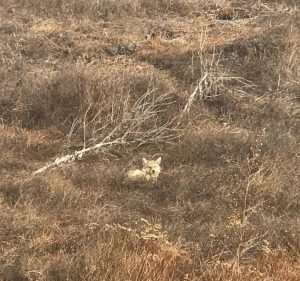
The weather is beginning to warm up and the animals are starting to become more active. During the winter months, you may have seen some Coyote tracks around, and thanks to one of our park visitors, Michael DeBoer, we have photographic evidence of its presence. While Coyotes (Canis latrans) have been known to take over fox dens, this one has been primarily seen on the Summerfest property and likely was just using the park as hunting grounds. It was seen by park staff in January, wandering around the Summerfest stages, and Michael DeBoer’s photographs were taken earlier this month on the berm area behind the American Family Amphitheater at the south entrance. Our Red Foxes (Vulpes vulpes) typically den in the rocky area in the northern half of the park.
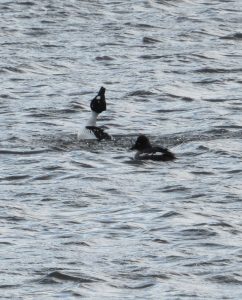
The birds are also becoming a bit frisky. Male Common Goldeneyes (Bucephala clangula) can be seen bobbing their head up and down while verbally calling for females. The Red Breasted Mergansers (Mergus serrator) are back, and the males will soon appear to be racing around the lagoons, showing off their speed to potential mates. Our yearly visitor, a leucistic (low-pigment) female Mallard (Anas platyrhynchos) appeared to have already chosen a mate, as she chased a particular male around the lagoon earlier this month.
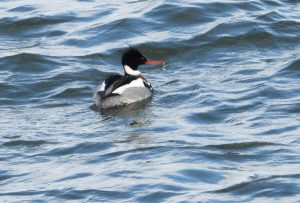
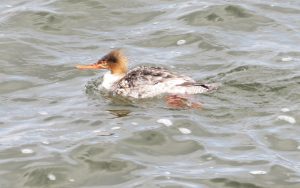
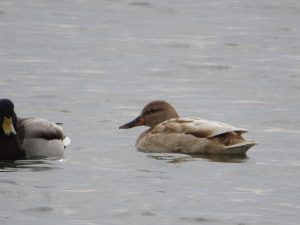
While you’re walking through, enjoy the mild weather and watch the waterfowl behavior. Share your photos of the park, or of your catch, with us on our facebook page, or email them to Angela.Vickio@wisconsin.gov. We’d love to see your photos! We’re getting closer to spring, so make sure to check our website or facebook page often for upcoming events!
Naturalist Notes February 2018
Naturalist Notes
February 2018
The temperatures have remained relatively stable, which means solid ice in the lagoon that is perfect for ice fishing. Waterfowl, however, do not share the same enthusiasm for ice cover. They are warmer and closer to their food source when they stay in open water areas during Wisconsin’s winters. The open water area under the bridge is a popular spot for waterfowl to congregate, especially since Lake Michigan is currently at 51% ice cover.
If you look closely at the waterfowl around the park, you will see 4 main species: Goldeneye, Mallard, Greater Scaup and Lesser Scaup (the scaups are also known as Bluebills).
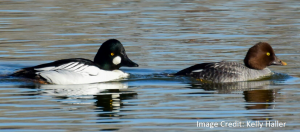
Goldeneye (Bucephala clangula)
Males: Black head with a white spot near the bill; black back with white sides
Female: Brown head with gray back and wings; black bill with yellow at the tip
Both: Bright yellow eyes; white patch on wings
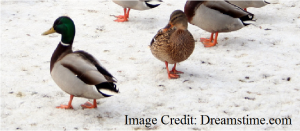
Mallard (Anas platyrhynchos)
Males: Dark, iridescent green head with yellow bill; gray body with black tail
Females: Mottled brown body with orange and brown bill
Both: Blue patch on their wing with a white border
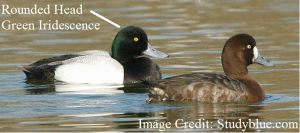
Greater Scaup (Aythya marila)
Males: Black head with green iridescence; dark grey/black tail, grey/white body
Females: Dark brown head; brown body; white base on bill
Both: Rounded head; blue-grey bill with a black tip
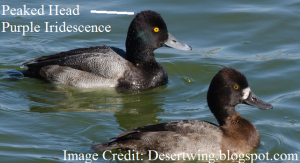
Lesser Scaup (Aytha affinis)
Males: Black head with purple iridescence; dark grey/black tail; grey/white body slightly darker than Greater Scaup
Females: Dark brown head and body with slight mottling; white base on bill
Both: Small peak/tuft on top of head; smaller than Greater Scaups
We’d love to see your photos! Share your photos of the park, or of your catch, with us on our facebook page, or email them to Angela.Vickio@wisconsin.gov. We are getting close to spring, so make sure to check our website or our facebook page often for upcoming events!
Naturalist Notes January 2018
Naturalist Notes
January 2018
The weather has gotten colder, and that means ice in the lagoon! Lakeshore State Park has had a busy ice fishing season, with multiple ice shanties up each day, and fishermen setting up tip-ups hoping to catch panfish and Brown Trout. Some have even still been successful in catching lingering Salmon near the harbor.
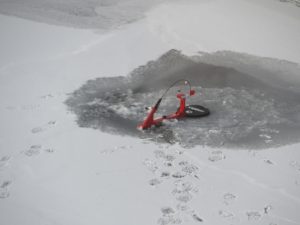
Stay safe on the ice! The lagoon can be highly variable due to its connection with Lake Michigan. This means that before venturing out, make sure you are doing so safely.
• Notify family/friends when and where you will be fishing, or better yet, bring a friend along!
• Check to make sure ice is at least 5-7” thick, and check ice thickness as you walk
• Look for clear ice, which is generally stronger than ice with bubbles or snow
• Carry ice picks or ice claws with you
• Have your cell phone in a waterproof case or bag
• Have a plan in case you fall through the ice. The DNR has ice fishing tips and other safety recommendations at http://dnr.wi.gov/topic/fishing/icefishing/index.html.
Free Fishing Weekend is coming up January 20th-21st and we will be celebrating at the park by handing out recipes, fish rulers, fish wildcards, and brochures. No license is required for free fishing weekends, but regulation catch lengths do apply.
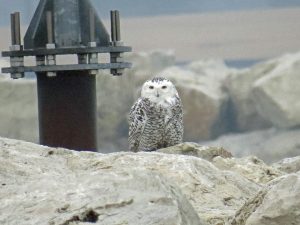
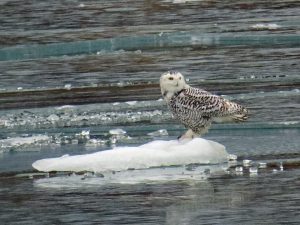
Fishermen, we’d love to see your catch! Share your photos with us on our facebook page, or email them to Angela.Vickio@wisconsin.gov. If you’re strolling through the park, keep a look out for the red foxes, they have become more active during the day as the temperatures remain cool. We also have a variety of waterfowl and other migratory birds passing through. The Snowy Owl in the photos below was attempting to catch himself a Scaup, according to park visitor Greg Osborne, who was able to observe and photograph the owl earlier this month.