It’s launch time for this year’s Friends Membership Campaign! We invite you to support our wonderful urban gem on the lake and enjoy all it has to offer.
2023 Highlights
Purchased 1,000+ native plant plugs and the mulch and equipment needed to install them
Recruited volunteers to help with spring plantings, pathway gravel installation, and stewardship to help combat invasive plants
Raised funds to pay for three new picnic tables
Awarded a Greater Milwaukee Foundation grant to fund a seasonal Park Educator and Intern
In partnership with Friends of Wisconsin State Parks, funded new plant signage and an educational program with Schlitz Audubon’s Eagle & Friends
Successfully hosted the second annual Brunch on the Beach
Successfully hosted the first annual Wild Flowers On The Water Festival
Sponsored Wilderness Inquiry’s Canoemobile for a second year
Installed signage to educate visitors on the park solitary bee houses
2024 Plans
Support a season park educator and an intern $27,000
Add gravel and seating to improve the kid’s prairie area $5,000
Replace circulators to prevent ice at marina (3 plus a spare) $4,228
Purchase a bird management laser for geese control $3,500
Matching funds for a DNR Incentive Grant to promote education in the park $900
Support local music in the park at Brunch By the Beach $700
Support local music and dance at Wildflowers On The Water, sponsorship levels starting from $250
For more information about our plans for 2024, please email us at admin@friendslsp.org
Please consider making a donation below today!
Park Pal Memberships Individual: $25 Family: $50Prairie Patron Memberships Rock Prairie: $100 Fox Prairie: $250 Kid’s Prairie: $500 Big Prairie: $1,000
Thank you! to the following members who recently joined or renewed:William Johnson Kate Freed Nancy Grainer
Pollinators in the Park
Summer brings warmer days with flowers, butterflies and bumble bees, and evenings made magical by fireflies. Lakeshore State Park provides these simple natural joys right on the shores of Lake Michigan. A new flower blooms or new insect buzzes here every day. Seemingly random, these occurrences are naturally orchestrated.
The habitat created at the park mimics a short grass prairie with native flowers and grasses with few trees. Native flowers bloom at various times of the season, attracting insects with nectar for sustenance, and the insects in turn pollinate the plants. These symbiotic relationships between the native plants and insects ensure successful reproduction for all involved.
One of the first to flower at the park is Prairie Smoke. Their pink flowers start out facing downwards at a height perfect for awakening bumble bee queens. After pollination, the flowers turn upright and unfurl their feathery blossoms in a smokey display. Next to bloom are Golden Alexanders, attracting tiny native bees which gather nectar and spread pollen plant to plant..
Ann Duffy leading a guided hike in the park. Photo by Eddee Daniel
Most bees are solitary, not living in hive colonies like non-native honey bees do. There are over 400 species of bees native to Wisconsin, many which can be found in the park including sweat, mason and leaf cutter bees. Ants, butterflies, and small birds and mammals can be pollinators too, and at night, moths and fireflies pollinate as well!
A concern of late is the decline of insects. Without them, we would have virtually no plants. And without plants, we would lose almost 50% of our food sources. Habitat loss and degradation and the overuse of pesticides are main factors causing dwindling insect populations. The average yard with a monoculture of non-native grass, decorated sparsely with non-native flowers and shrubs, provides little habitat for pollinators.
What can be done to help? Planting native flowers and grasses in our yards would provide a variety of beautiful, native habitat where native pollinators can thrive. In turn, the pollinators would help the native plants, thus freeing one to spend less time and effort maintaining a yard and more time enjoying the great outdoors!”
June 2024 Newsletter
We Have More Prairie Plants!
Over a few days in May, DNR staff and dozens of volunteers planted more than 1,200 native plant plugs in the park prairies. Recent soaking rains have helped these plants root into the hard soil – come to the park to see beautiful blooms as the plants mature! Many thanks to Friends of Lakeshore State Park volunteers and donors for their generosity – the prairies would not be the same without you!
Photos with DNR and Prairie Pal volunteers from the Garden Club of Greater Milwaukee. The Prairie Pals were recently awarded the Wisconsin Civic Achievement Awardgiven by the Wisconsin Garden Club Federation – congratulations Prairie Pals!
Volunteers are very welcome to help in the prairies June 11th and 25th 10AM-12PM, and alternate Tuesdays through October
Upcoming Events
All events meet at park north entrance near Discovery World, unless otherwise indicated
Jun 1: Free Fishing Weekend Fishing Clinic, 1:00-3:00PM Jun 4: Wildflowers on the Water happy hour kickoff, 4:00-6:00PM Wantable Cafe, 123 E Walker St. Jun 7: Bike Week Commuter Station, 7:30-10:00AM in front of Discovery World Jun 15: Prairie Hike, 10:00-11:00AM. Jun 16: Father’s Day Fishing, 2:00-3:30PM Meet at the fishing pier Jun 18: Summer Solstice Hike, 7:00-8:00PM Jun 19: Bubble Hike, 5:00-6:00PM Jun 19: Beach Bonfire, 6:00-8:30PM Meet at Pebble Beach Jun 22: Invasive Species Awareness Day, 9:00AM-12:00PM Meet at the fishing pier Jun 27: Pride Month Hike, 6:00-7:00PM
Jul 7: Brunch By the Beach with Food Trucks and Music 10:00AM-2:00PM Jul 24 : Bonfire with Smores 6:00-8:30PM Aug 21: Bonfire with Smores, Lakefront Beer and Food Truck 6:00-8:30PM Sep 7: Wildflowers on the Water – Music, Food and Art 3:00-7:00PM Sep 18: Bonfire with Smores 5:30-730PM
Our park educators offer a wide variety of programs for both kids and adults, such as fishing clinics (no license required for children 15 and under) and events that focus on nature education and exploration, all designed to be hands-on and family-friendly.
Milwaukee Riverkeeper Cleanup a Success
At first glance, our park may look quite clean.
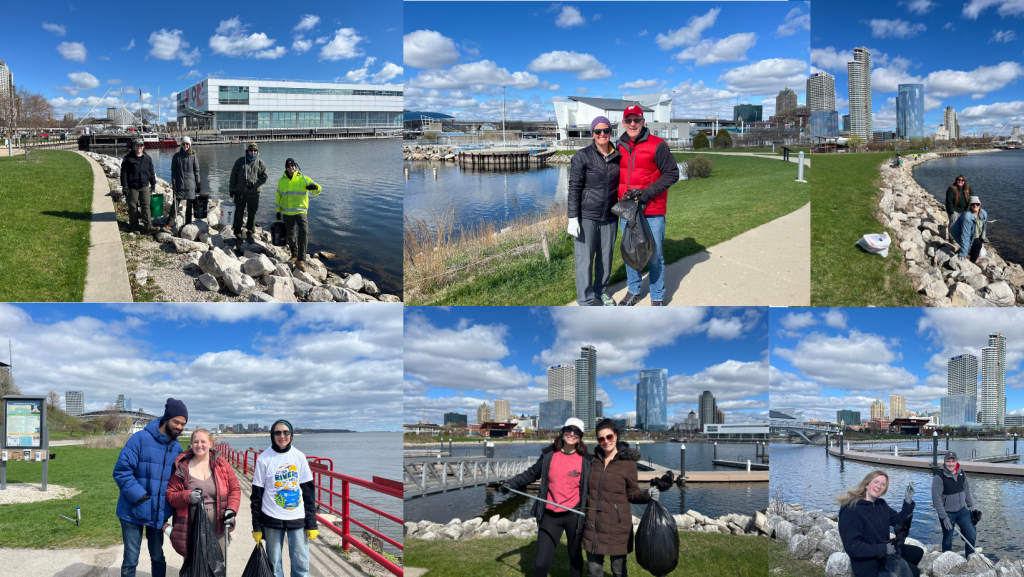
Upon closer inspection though, one might find many plastic bottles and smaller trash such as microplastics in some areas. This trash negatively impact park wildlife and water quality. Thanks to our partnership with Milwaukee Riverkeeper and the support of our volunteers, our park is kept cleaner for all.
Our most recent cleanup was completed on a brisk and sunny April 20th, when 23 volunteers and the DNR got together and collected 17 bags of trash! Afterwards, several of us celebrated the day with other partner organizations and volunteers at Rock The Green. Thank you Riverkeeper, the DNR and volunteers!
Water quality impacts people, plants, and animals. Many species of birds frequent the park, including high numbers of Canada Geese. The geese feed on grass in the park, leaving excrement which negatively impacts water quality and the experience of over 450,000 annual visitors.
Thanks to a generous grant from Fund For Lake Michigan, FLSP will contract Migratory Bird Management to spray Flight Control® Plus, a non-toxic spray which deters goose populations from taking up residence in the park. Visitor experience will be enhanced through fewer goose droppings, enabling park patrons to walk freely and enjoy clean, green spaces. Thank you Fund For Lake Michigan!
Bird City Milwaukee
It’s not only winter-worn Milwaukee residents who flock to the lakefront and parks as May rolls around. Birds do too. And lots of them!
One reason is that Milwaukee is situated in the Mississippi Flyway. And, as Bird City Milwaukee notes, we have over six miles of lakefront and more than 250 hotspots scattered around the area. That’s a big draw for birds throughout the year. And it’s why having safe and bird-friendly environments is so important.
Bird City Milwaukee (BCW), a member of Bird City Wisconsin since 2012, is dedicated to doing just that. It provides education and support to help communities establish and maintain good bird habitats. During its initial years in Milwaukee, BCW was spearheaded by the Urban Ecology Center (EUC), but gradually the management is being turned over to Visit Milwaukee. As Tim Vargo of the Urban Ecology Center explains, the hope is that under the helm of Visit Milwaukee, Bird City will become “a networking/communication/marketing hub and a go-to place for anybody who wants to know what is happening in Milwaukee any month.”
To get involved with Bird City Milwaukee, check out its website, social media and Facebook pages. And UEC’s Vargo suggests people can also support the Bird City cause by simply going on a bird walk. If you’re a newcomer to birding, not to worry. “So many groups love it when new birders come because it’s sharing their passion,” Vargo says. “My suggestion is to get out with someone who can be a mentor and just do it over and over again. The first couple of times it might feel overwhelming but the more you do it, the easier it will be.”
A networking/communication/marketing hub and a go-to place for anybody who wants to know what is happening in Milwaukee any month.
Tim Vargo
May is a great month to get started. Not only is it prime migration season—May 11th is World Migration Day—it’s when the annual Brew City Bird Fest is held! The Urban Ecology Center will be avian central for the fest, May 10-17, offering a variety of cheep fun and informative events, including morning bird walks; a Bird in Arts program; and a Keynote Lecture—Birdie Big Year: Elevating Women Birders by Tiffany Kiersten. A full listing of activities can be found on the Urban Ecology Center website.
The Friends of Lakeshore State Park will also be celebrating World Migration Day with a Bird Hike for all ages on Friday, May 10th at 9:30 a.m. Come join us as we search the skies and shore for some of our favorite species. Check our events page for details.
Birds love our city. By supporting Bird City Milwaukee, you can give them a little love them back.
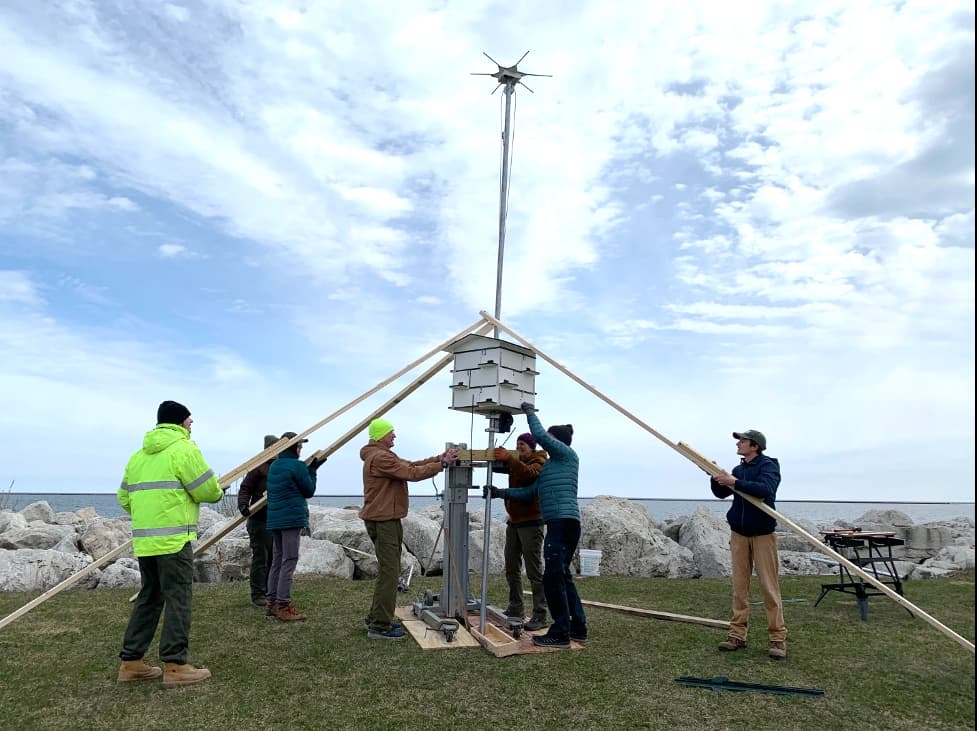
On April 5th, the installation of a new purple martin bird house was completed. The house is in the same location on the north end of the park just south of the bridge as the previous house. The house was generously donated by Katie and Doug Fisher. The installation took part in stages and was completed by DNR personnel and volunteers.
Some interesting facts about the installation:
The recommended height for a purple martin houses is 10 – 20 feet
The house weighs about 72 lbs.
An existing steel tube in the ground with a 2” inside diameter was re-used
A Schedule 40 steel plumbing pipe was used that fit into the existing tube.
Volunteer engineers designed the system to withstand 100 mph gusts
Purple martins exhibit site fidelity and they are back! (as seen in photo at top of page)
May 2024 Newsletter
Hello Friends!
Warmer temperatures are waking up the flora and the fauna at Lakeshore State Park! Near the marina, resident groundhogs can be seen enjoying the spring sun. They are highly adaptable, able to live in various habitats. Lakeshore’s riprap and prairies offer a unique environment for a safe home, with plenty of vegetation for them to munch on. Though our groundhogs are curious and used to humans, those lucky enough to view them should watch from a respectful distance.
The prairies are also coming alive! Look for signs of life while walking through the park and reading our new informational signs on blooming plants. Prairie Smoke (Geum triflorum) is one of our first bloomers with their clusters of low growing, reddish pink flowers. We have signage with info about them in the demonstration prairie beds north of the pedestrian bridge.
The DNR will be installing sign stakes as more plants bloom by the month. Information can be found at “what’s in bloom” in park kiosks as well. And the DNR staff are hard at work removing invasive and aggressive species from the park’s prairies, as well as preparing areas for new, native plantings.
Keep an eye out for volunteer weed-out and planting dates coming soon!
May 1: May Day Hike, 6:00-7:00 PM Meet north entrance of the park, near Discovery World May 3: History of Lakeshore State Park Hike, 2:00-3:00 PM Meet near Discovery World May 5: Great Lakes Awareness Walk, 3:00-4:00 PM Meet near Discovery World May 8: Wildflower Walk, 6:00-7:00 PM Meet near Discovery World May 10: Bird Hike, 6:00-7:00 PM Meet near Discovery World May 11: Public Fishing Clinic, 1:00-3:00 PM Meet at fishing pier, along the western path May 12: Mother’s Day Hike, 3:00-4:00 PM Meet near Discovery World May 15: Fossil Hike, 5:00-6:00 PM Meet near Discovery World May 15: Beach Bonfire 6:00-8:30 PM Meet at Pebble Beach, along the park’s western path. May 17: Mushroom Hunt, 6:00-7:00 PM Meet near Discovery World May 19: World Bee Day Walk, 3:00-4:00 PM Meet near Discovery World May 22: Edible Plants Walk, 6:00-7:00 PM Meet near Discovery World May 24: Spring Scavenger Hunt, 6:00-7:00 PM Meet near Discovery World May 29: Snail Trails, 6:00-7:00 PM Meet near Discovery World
May 15th 6pm-8:30pm. Evening bonfire with smore’s Jun 19th. 6pm-8:30pm. Evening bonfire with smore’s Jul 7th 10am-2pm. Brunch By the Beach with food trucks Jul 23rd. 6pm-8:30pm. Evening bonfire with smore’s Aug21st. 6pm-8:30pm. Evening bonfire with smore’s Sep 7th. time TBD. Wildflowers By the Water: Music, Food and Art Sep 18th 5:30pm-7:30pm. Evening bonfire with smore’s
Our park educators offer a wide variety of programs for both kids and adults, such as fishing clinics (no license required for children 15 and under) and events that focus on nature education and exploration, all designed to be hands-on and family-friendly.
Sturgeon Protectors Signal Hope for our Rivers
For the first time in many years, sturgeon are returning to our rivers.
This has been the result of efforts by many groups, which Michael Timm reflects on in his recent article published in Urban Milwaukee: “Why do we care about the Sturgeon?”
When Sturgeon return home, we should be thinking about what kind of home that place will be. Like us, as Native people, sturgeon had been removed from their original homelands…so now our relatives are able to return, but return to what?
One of the groups that has been instrumental in the return of the sturgeon are the Milwaukee Sturgeon Protectors which use both native knowledge and environmental science to help heal the river. Mark Denning, a member of the Sturgeon Clan in the Oneida Tribe of Wisconsin wrote “When Sturgeon return home, we should be thinking about what kind of home that place will be. Like us, as Native people, sturgeon had been removed from their original homelands…so now our relatives are able to return, but return to what?”
The ability of our rivers to support spawning sturgeon has been on the minds not only of Sturgeon Protector members, but also children in nature science classes. Children are involved not only in measuring water quality through their classes, but they are also some of the most enthusiastic sturgeon releasers during Sturgeon Fest. To learn more about the Sturgeon Protectors, please contact them at https://sturgeonprotectors.org
Education and awareness are key parts of the ethos of the Sturgeon Protectors, who were inspired by literal protectors preventing poaching during spawning season. The Sturgeon Protectors have many members from different environmental organizations around Milwaukee including Riverkeeper, Friends of Lakeshore State Park , UW-Milwaukee School of Freshwater Sciences, and Wisconsin Green Fire, among others. The repair of our riparian environment is not only beneficial for Sturgeon, but for other native fish – and humans too. These long-lived fish will hopefully return to cleaner rivers that will continue on the path of restoration as the next generation becomes involved in their protection”
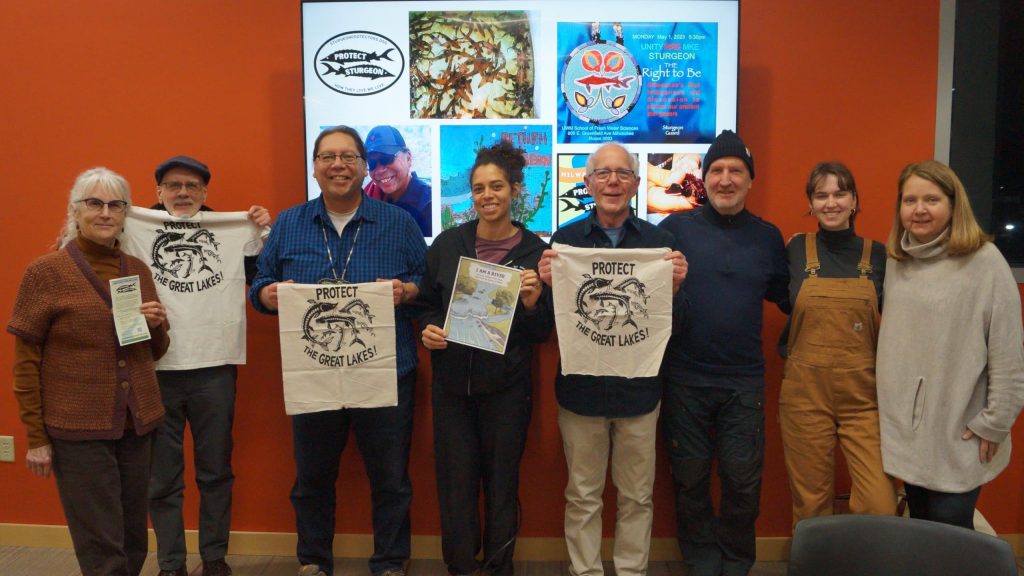
Several members of the Sturgeon Protectors group meet at the UW-Milwaukee School of Freshwater Sciences on Feb. 1, 2024. From left to right: Anne Steinberg, Eric Hansen, Mark Denning, Shirley Aspinall, Don Behm, David Wenstrup, Clare Eigenbrode, and Cheryl Nenn. Photo by Michael Timm.